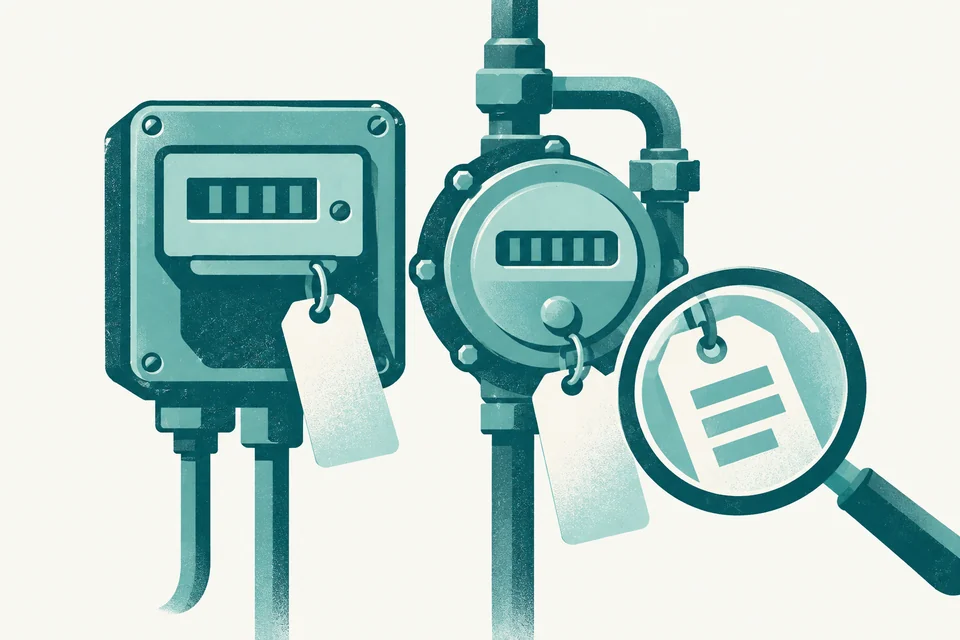
Your MPAN identifies an electricity supply point, your MPRN identifies a gas supply point, and a meter serial number identifies the physical meter. They are different from your supplier account number. Start with a recent bill, then check any missing details with the supplier or relevant network. This guide covers business supplies in Great Britain.
What is the difference between MPAN, MPRN and meter number?
| Identifier | What it identifies | Where to start |
|---|---|---|
| MPAN: meter point administration number | An electricity supply point | The electricity bill's supply-details section. |
| MPRN: meter point reference number | A gas supply point | The gas bill's supply-details section. |
| Meter serial number, sometimes called MSN or meter ID | The physical meter | The bill and the label on the meter. |
| Supplier account number | Your account with that supplier | The bill or account correspondence. |
British Gas business's identifier guide explains these distinctions. When someone requests a number, ask which one they need rather than sending an unlabelled photograph or assuming “meter number” has one meaning.
For several premises, keep a supply register with a row per supply. Give each row a clear site name and record the fuel, identifier and source document.
Find the electricity MPAN on the bill
An electricity bill may show a boxed supply number with an “S” and additional information above a bottom row. The core MPAN is the 13-digit reference. UK Power Networks' connection guidance identifies that 13-digit reference as the electricity supply-point identifier.
British Gas business explains that it normally asks for the last 13 digits shown in the supply-number display. Other forms may ask for additional details, so follow the specific request. Do not confuse the core reference with the account number or a meter-reading value.
If there is no bill, ask the relevant network operator how to identify the supply and registered supplier. UK Power Networks' lookup, for example, covers London, the South East and East of England; it is not a national service. Use the operator appropriate to the property's network area.
If the premises generate electricity, check the import and export references separately. UK Power Networks explains that its standard lookup concerns the incoming supply, with a separate route for an export MPAN. An import bill alone may not identify a solar export agreement.
Check the address and unit number beside the MPAN. At a shared building, an old bill for the whole property may not identify the individual supply you need. Keep uncertain matches marked as unconfirmed until the supplier or network resolves them.
Find the gas MPRN when paperwork is missing
Check a recent gas bill first. If you do not have one, Xoserve's consumer guidance links to its Find My Supplier service, which helps identify the registered gas supplier. Its A-to-Z explanation describes the service as providing the MPRN and gas transporter as well.
Use the exact premises address and check the returned details carefully. Ask the landlord or managing agent for supporting records where a building has been divided, renamed or redeveloped. A postcode match alone is not enough to establish which pipe serves a particular unit.
If records are missing or contradictory, contact the supplier for investigation. Xoserve explains that corrections to its central gas records must be progressed through the relevant industry parties; customers should start with their supplier rather than trying to overwrite the record themselves.
Check the physical meter separately
The serial number is normally printed on the meter's identification label, often near a barcode. Compare it with the bill, keeping a dated photograph if access is safe and authorised. Do not enter locked or hazardous areas or disturb seals to obtain it.
Hypothetical example: a bill lists the correct unit address but a different meter serial number from the meter you have photographed. That discrepancy needs investigation; it does not prove by itself that the supply identifier or bill is wrong. A meter exchange or a record mismatch could need checking.
Send the supplier the relevant invoice, photograph and dates. Ask it to reconcile the supply point, physical meter and account before using uncertain information for a contract or meter appointment.
Keep a verified supply register
Record who confirmed each identifier and when. Retain meter-exchange paperwork, and update the physical meter details when equipment changes. Do not replace a supply identifier simply because a new meter has been installed or a supplier changes.
Use the register for renewal enquiries, bill checks and project briefs. If a new building has no confirmed supply identifier, ask the connection project team what has been created and which steps remain; an identifier alone is not proof that a meter is fitted or the premises are ready to use energy.
BBA Energy's procurement and meter-coordination services can help organise supply information and the questions requiring confirmation.